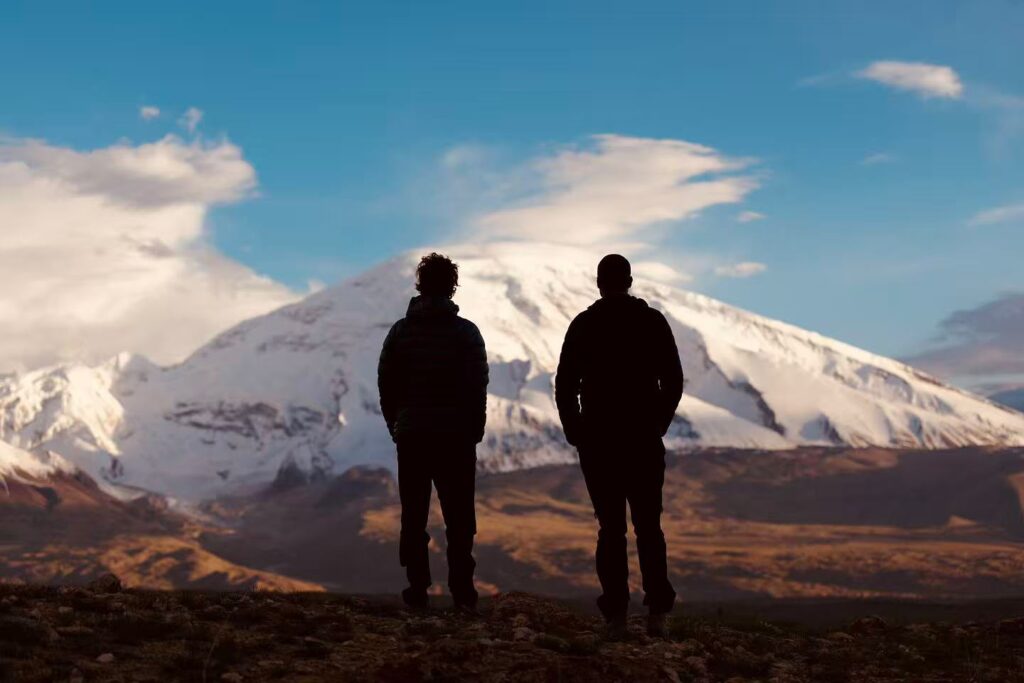
Muztag Ata Sometimes the Detour Becomes the Adventure
There may be no mountain in the world better suited for skiing than Muztag Ata (7,546 m). Its long, gentle snow slopes with very few steep sections make it a dream mountain for ski mountaineers. Camp 3, located at around 6,800 metres, is also an ideal place to gain experience living and climbing at high altitude excellent preparation for a future 8,000-metre expedition.
Full of anticipation, we travel to China, a country I had heard and read a great deal about but had never visited before. During our first days in the mountains, we stay in traditional yurts heated by a coal stove. To my surprise, there is even a sauna. Before continuing towards the Chinese border, we make an acclimatisation hike along a mountain ridge to around 3,800 metres.
From there, a completely different adventure begins. Almost everywhere we go, we have to register, show our passports and pass through security checkpoints. After a while, I lose count of how many times we have to hand over our travel documents. Apparently, that’s just part of travelling here.
By the time we finally reach base camp, we are exhausted. With the sun already setting, we decide to climb the small hill behind camp. Then, at last, she appears: Muztag Ata, slowly emerging from the clouds. Huge, white and impressive a mountain that simply invites you to climb it and ski back down.
One of the great advantages of this base camp is that it can be reached by jeep. That makes the expedition far more flexible than most. If the weather turns bad or plans change, it is relatively easy to move to another objective.
We immediately take advantage of that flexibility. Since we do not know when or even if we will be allowed to climb Muztag Ata, we decide to make an acclimatisation ascent of Kezi Sel, a peak in the Kongur Tagh massif. The journey alone is an adventure: a true 4×4 expedition across rough tracks through spectacular scenery. Kongur Tagh was first climbed by the legendary British mountaineer Sir Chris Bonington—a story in itself.
Unfortunately, the weather continues to disappoint. Instead of waiting in frustration at base camp, we decide to spend two days in the town of Tashkurgan. It is wonderful to enjoy the comfort of a hotel, take a long shower and eat well again. Equally rewarding is the opportunity to learn more about the culture of the Uyghur people. Moments like these make an expedition about much more than reaching a summit.
Still, the uncertainty remains. Will we ever be allowed onto the mountain? Time is running out, and eventually we decide to stop waiting. We switch to Plan B and set off for Peak Lenin, a day and a half’s drive away in Kyrgyzstan.
As a mountaineer, you sometimes have to accept that your original objective is simply no longer achievable. That is part of expedition climbing. The real challenge is to stay flexible and recognise opportunities where others see only disappointment.
On Peak Lenin, everything goes surprisingly smoothly. We climb through Camps 1, 2 and 3 before finally reaching the summit of this magnificent 7,134-metre peak. It is not the mountain we originally came for, and not the ski descent we had dreamed of. But we do return home with another beautiful 7,000-metre summit behind us.
Looking back, this journey became much more than an unsuccessful attempt on Muztag Ata. We travelled through several countries, spent countless hours waiting at border crossings, constantly adapted our plans and gained a deeper understanding of how different cultures and systems work. By staying flexible, we experienced an adventure we could never have planned.
Expeditions rarely go exactly as intended. Sometimes, taking a different path creates the best memories.
And Muztag Ata?
It is still on my list. Because, to be honest, I still dream of one day skiing down that magnificent white mountain.